
Summary
Website Lead Funnel Strategy for Small Businesses | My Business Blitz
Are you accidentally turning away your best leads before they even contact you?
Many small businesses invest time and money into marketing. They improve their website design, run ads, or try search engine optimization (SEO). But when visitors finally arrive at their website, something unexpected (and tragic) happens.
They leave without contacting the business.
Often, the problem is not traffic. The problem is the website lead funnel.
A website lead funnel is the system that guides visitors from discovering your business to becoming a paying client. When this funnel is designed poorly with something like a DIY website, potential customers may feel overwhelmed or confused and leave before taking action.
The good news is that small changes to your website lead funnel can dramatically increase the number of leads you receive.
In this guide, we’ll explain how a website lead funnel works, how to qualify leads without scaring them away, and how to design a funnel that helps your business grow.
Want to watch the video? Click here.
What Is a Website Lead Funnel?
A website lead funnel is the path a visitor takes from discovering your website to becoming a customer.
Think of it like a guided journey.
When someone first finds your business online, they usually move through several stages:
- Awareness – They discover your website through Google, social media, or referrals.
- Interest – They explore your website to see if you can solve their problem.
- Lead Capture – They contact you through a form, call, or booking system.
- Lead Qualification – You determine if they are the right fit for your services.
- Conversion – They become a paying client.
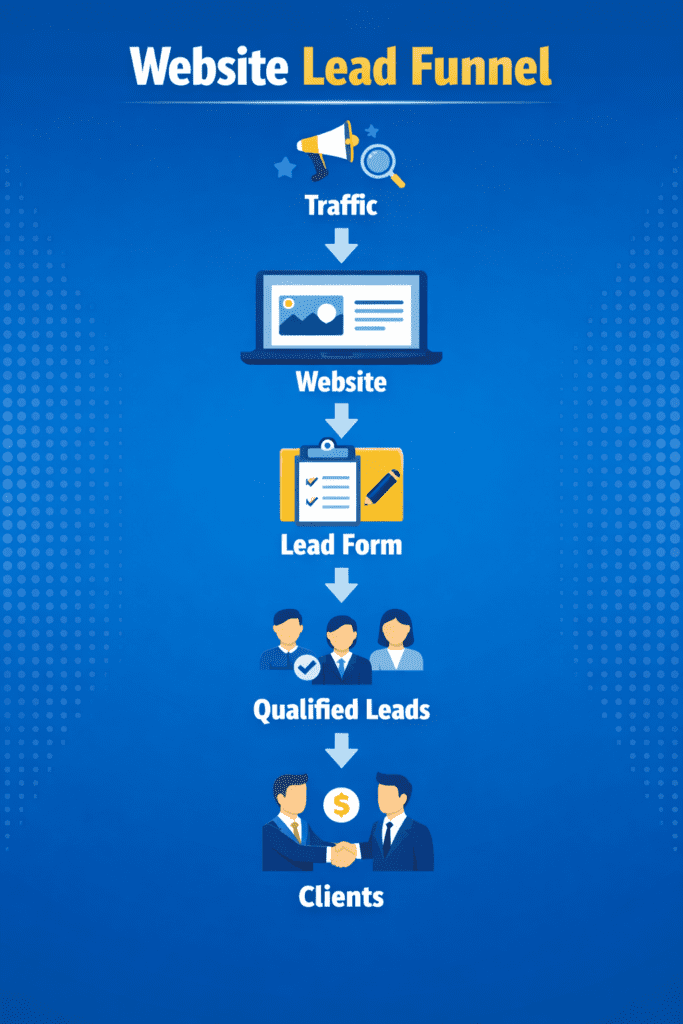
Without a structured funnel, visitors often leave before reaching step three.
According to research from HubSpot, companies with effective marketing funnels generate 50% more sales-ready leads at a 33% lower cost.
A well-designed website lead funnel helps guide visitors naturally toward contacting your business.
Why Lead Qualification Matters
Not every lead will be the right fit for your services.
This is where lead qualification comes in.
Lead qualification simply means determining whether a potential client has the right needs, timeline, and budget for your services.
For example, many businesses qualify leads based on:
- Budget
- Timeline
- Project size
- Industry
- Location
This can be where many websites make a mistake, especially if they have a successful SEO campaign and are receiving more leads than before.
Instead of gently qualifying leads, they try to gather too much information too early.
The Job Interview vs First Date Problem
Your website lead funnel should feel like a first date, not a job interview.
Imagine meeting someone for the first time. If they immediately start asking dozens of detailed questions, it feels overwhelming.
The same thing happens on many websites.
Visitors arrive interested in learning more about your business. But when they try to contact you, they see a long form asking:
- company revenue
- project scope
- marketing goals
- timeline
- budget
- technical questions
Suddenly the process feels complicated.
Instead of completing the form, many people simply leave.
According to usability research from Baymard Institute, complicated forms are one of the most common reasons users abandon online processes.
Your website lead funnel should make contacting you easy and welcoming.
The Simple Lead Qualification Strategy That Works
The best website lead funnels start with simple qualification questions.
Instead of asking fifteen questions, start with just one or two qualifying questions.
For example:
What is your estimated budget for this project?
- $1,000 – $3,000
- $3,000 – $10,000
- $10,000+
Or:
When would you like to start?
- Immediately
- Within 3 months
- 3–6 months
These questions give you helpful information while keeping the form quick and easy to complete.
You can gather more details later during a discovery call or your first appointment.
Why Simplicity Improves Conversion Rates
A strong website lead funnel reduces friction.
Friction is anything that makes it harder for visitors to take action.
When your website removes friction, more visitors become leads.
According to marketing research from WordStream, the average website conversion rate across industries is about 2–5%.
That means out of 100 visitors:
Only 2–5 people typically contact the business.
Improving your website lead funnel can significantly increase that number.
Even small improvements can double or triple your leads.
What Happens After Someone Becomes a Lead?
A good website lead funnel does not stop at the contact form.
Once someone becomes a lead, the next step is lead nurturing.
Lead nurturing means building a relationship with potential clients until they are ready to buy.
Some leads are ready immediately. Others may need weeks or months before making a decision.
Businesses often nurture leads by:
- sending helpful emails
- sharing educational content
- offering free resources
- providing consultations
According to DemandGen Report, nurtured leads make 47% larger purchases than non-nurtured leads.This is why nurturing is an important part of a website lead funnel.
The Biggest Funnel Mistake Growing Businesses Make
As businesses grow and receive more inquiries, they sometimes try to filter leads too aggressively.
They add more questions to their forms hoping to qualify leads faster.
Unfortunately, this often backfires.
If your website lead funnel becomes too complicated, fewer people will complete the form.
Instead of filtering leads, the funnel simply reduces the number of leads altogether.
Unless your business is receiving hundreds of inquiries every week, it is usually better to keep your funnel simple.
What a High-Converting Website Lead Funnel Looks Like
A high-converting website lead funnel usually includes:
- Clear messaging that explains what you offer
- A simple contact form with 3–5 fields
- One or two qualifying questions
- A thank-you page explaining next steps
- Automated email follow ups
When these pieces work together, your website becomes a powerful lead generation system. Need help getting your website on track? Check out your options to succeed.
Why Strategy Matters in Website Design
Many websites are designed visually but not strategically.
At My Business Blitz, every website is built with marketing strategy in mind.
Instead of simply designing pages, we focus on:
- lead generation
- SEO visibility
- conversion optimization
- messaging that attracts ideal clients
This approach turns your website into a system designed to generate business results and ROI.
Learn more about our website design approach.
You can also read more marketing insights on our blog:
https://www.mybusinessblitz.com/blog
Watch the Video Version
Prefer a quick explanation?
Watch this short video where we explain how website lead funnels qualify leads without scaring them away.
Ready for a Website That Generates Leads?
If your website gets traffic but few inquiries, the problem is often the funnel.
A well-designed website lead funnel helps your business:
- attract the right visitors
- qualify leads automatically
- convert interest into real inquiries
At My Business Blitz, we build websites designed to do exactly that.
If you’re ready for a website redesign combined with SEO strategy that generates consistent leads, request a free SEO audit today.
Ready to get started now?